
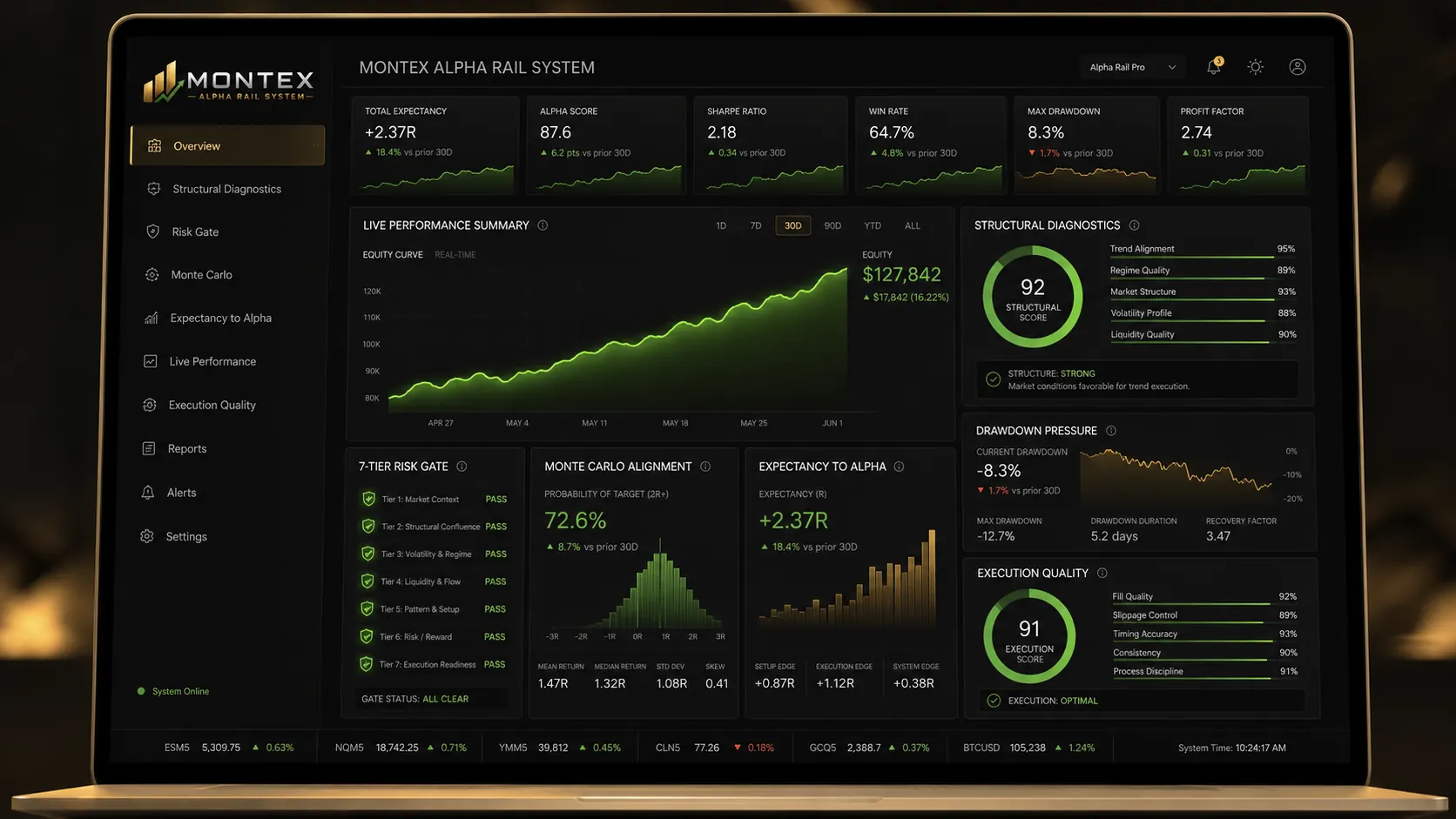
Platform — The Name
Monte Carlo + Expectancy. The name is the doctrine.
Worked example
Every decision in MARS is routed through this hierarchy in order. The plan defines doctrine; gate state defines capital posture; the throttle converts posture into deployment numbers; evidence and diagnostics inform from below; R&D stays sandboxed at the bottom until validated. When layers disagree, the higher layer wins - always.
The MARS authority stack. Authority flows down; evidence flows up; nothing lower may override anything above it.
Layer 01 — MON — Monte Carlo
The ruler, not a motivational target.
50,000 simulated paths across 52 weeks with the gate-aware allocator define what the system should reasonably expect. Live performance is read against median and percentile bands — the trader is not supposed to panic below median or worship a lucky P90 month.
Layer 02 — TEX — Expectancy
The master live grader.
Monte Carlo says what should happen; expectancy says what is happening. If live EV exceeds the model while drawdown stays controlled, that is where genuine alpha begins — but EV never stands alone. RAPF, RAER, and ACCEL must confirm it.
Layer 03 — ALPHA + RAIL
Outperformance, with guardrails.
Alpha in MARS means benchmark outperformance after risk, drawdown, deployment quality, and structural integrity are accounted for. The Rail is the guardrail layer — gates, brakes, badges, tier caps, directives, percentile bands, System Lock — that keeps the trader from destroying the edge while extracting it.
Reference
The vocabulary, precisely
| Term | Meaning inside MARS |
|---|---|
| Alpha | Excess return beyond what variance alone would explain — the thing expectancy becomes when it is governed |
| Rail | The governed path capital is allowed to travel: gates, tiers, and brakes that bound every deployment |
| Expectancy (EV) | Expected value per trade in R — the master metric every module answers to |
| Gate | The drawdown-from-equity-peak state that caps how much tier the system may use |
| Tier | T1–T7: the authorized risk pool for the next 4-trade cycle — an output of evidence, never an input of confidence |
| Branch | One of four execution regimes — Normal, Trend Partial, Trend No-Partial, Overflow — each with its own expectancy model |
The governing idea
Inside this module
3 pages go deeper than this one.
Connected inside MARS
This module doesn't work alone.
Go deeper
Operator briefs on this territory.
Deep dive — 01
Expectancy arithmetic: what a trade is worth before it happens.
The EV formula walked end to end — why per-trade worth beats realized P&L as the master metric.
Read the full brief →
Deep dive — 02
Mon and tex: Monte Carlo is the ruler, expectancy is the grader.
Monte Carlo says what should happen. Expectancy says what is happening. Alpha lives in the gap.
Read the full brief →
Deep dive — 03
AlphaRail: why the guardrails are the product.
Metrics tell you things. Rails make you do things. The guardrail layer is where MARS becomes an operating system.
Read the full brief →

Every module ships in the complete MARS package.
One price. Eleven workbooks, three TradingView indicators, and the full manual library — $497.