Skip to content
← Back to What Montex Means

Operator brief · 55

AlphaRail: why the guardrails are the product.

The key idea

The metaphor's precision

Rails control direction without removing movement.

The word was chosen carefully. A cage prevents action; a rail shapes it. MARS doesn't remove trader discretion — it puts discretion on rails, leaving the operator to decide which setup is valid, which branch it belongs to, whether volatility context is acceptable, whether the trade is worth taking, and how to manage it. What the rails control is the boundary set: what gate the account is in, what tier is allowed, what cycle pool is authorized, how much open exposure is already committed, and whether full deployment is permitted. Movement stays free within a track that makes the catastrophic exits structurally hard to reach.
The guardrail inventory

The rails are made of specific, firing signals — not a philosophy.

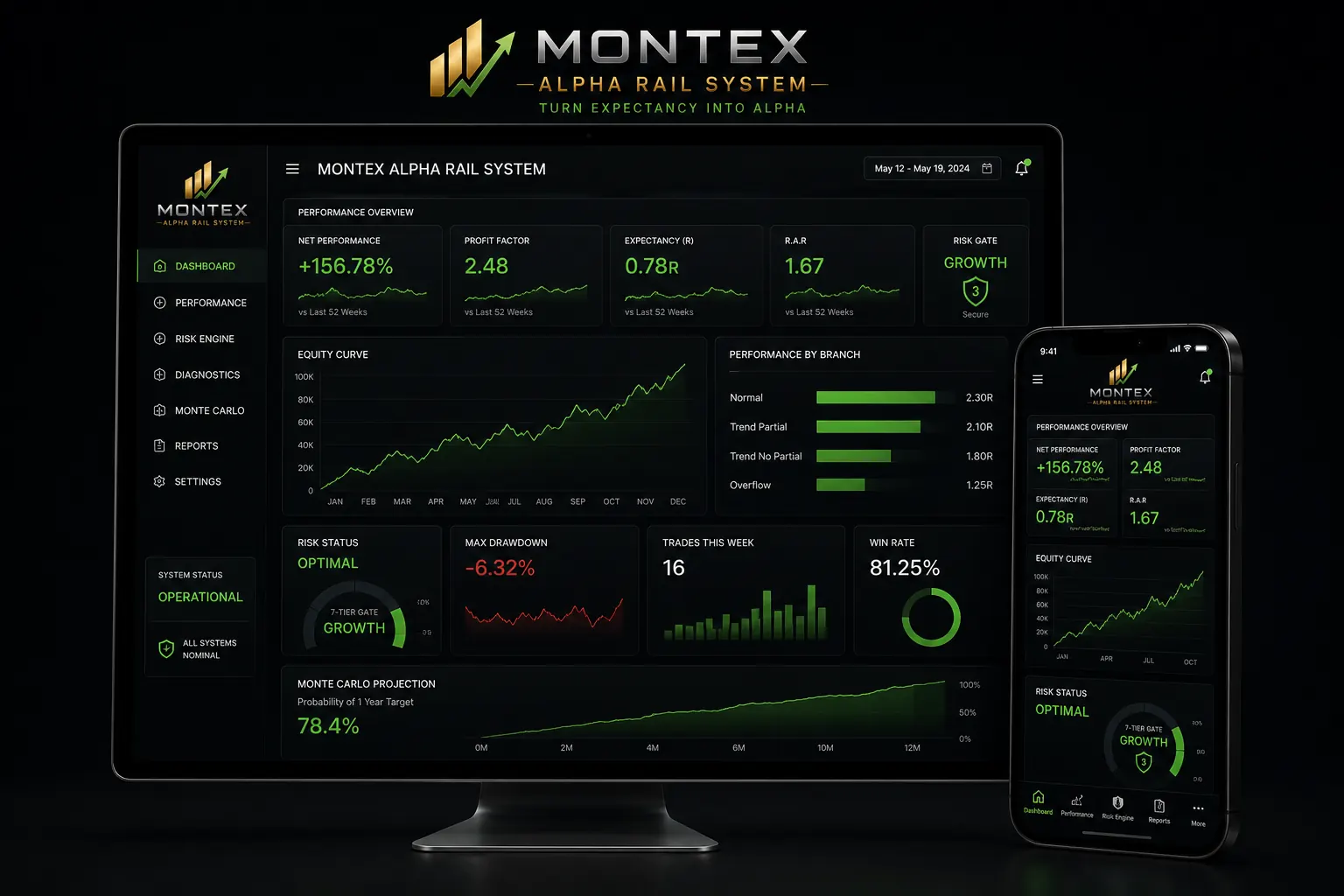
The guardrail layer is a concrete inventory, and its breadth is the point: EV status colors, drawdown gate states, brake states, tier caps, throttle directives, smart-exposure warnings, fee-drag warnings, quota discipline flags, branch health reads, volatility regime classifications, ATR trend and normal states, MAE/MFE efficiency grades, RAPF and RAER contradiction states, structural diagnostic bands, regime labels, benchmark percentile bands, live-versus-benchmark deviation flags, the System Lock boundary, and the manual override log. Each one is a translation of some metric into a state that carries a behavioral implication — continue, caution, compress, review, stop, do not expand.

FigureHow a metric becomes a rail
measurement becomes behaviorRaw metricEV, drawdown %, exposure, capture ratioThreshold stategreen/yellow/red, gate band, efficiency gradeBehavioral directivecontinue, caution, compress, review, stopDeployment consequencecap, pool row, veto, or authorization

The guardrail layer's function is the middle transformation: a number becomes a state, a state carries a directive, and the directive constrains the next cycle's deployment.

Why translation is the commercial value

Traders don't lack metrics. They lack metrics that bind.

Almost any modern journal or platform will compute expectancy, drawdown, and win rate. What almost none of them do is convert those numbers into pressure on the next decision. A number that reports is information; a number that caps is governance. The difference shows up precisely in the moments that matter — after three losing days, with a compelling setup on screen and an account already carrying open risk, an expectancy figure sitting passively on a dashboard exerts no force at all, while a gate state that has already re-priced the pool row does. The rails exist because the gap between knowing and doing is where most edges are lost, and it doesn't close through better reporting.

  • A metric that reports leaves the decision to the operator's state of mind. A rail decides in advance.
  • The signal set is deliberately broad — most failure modes announce themselves on some axis before they show up in equity.
  • Rails must be able to fire against the operator's preference, or they aren't rails.

What the rails don't touch

The track is wide where judgment belongs.

The rail metaphor also sets a limit worth stating: nothing in the guardrail inventory generates entries, ranks setups, or tells the operator that this trade is better than that one. There's no signal saying take this. The rails cluster entirely around capital exposure and structural health — the dimensions where automatic enforcement outperforms in-the-moment judgment. Where judgment genuinely outperforms rules, the track is left deliberately wide. A system that railed trade selection too would be a different product with a different failure mode: it would be brittle exactly where markets are most various, and it would have removed the part of the process the operator is actually best at.

The key idea

Rails are what make a measurement stack into an operating system.

Montex measures; AlphaRail enforces. Without the second half, MARS would be an unusually thorough analytics suite that traders would consult when calm and ignore when it counted. The guardrails convert every measurement into a state with consequences for the next cycle's deployment — which is what makes the whole apparatus survive contact with a bad week. Derailment stays possible; it just requires a deliberate, logged, visible act rather than a quiet drift. That difference, sustained over years, is the entire mechanism by which an edge is allowed to compound.

Connected inside MARS

Every brief documents the same shipped system.

The complete MARS package — eleven workbooks, three TradingView indicators, the full manual library — $497.