
Variant Attribution · Seven-Lens Test
A variant is valid only when the lenses agree.
Layer 01 — The seven-lens permission test
A variant is valid only when the lenses agree.
From the Branch Variant Selection Matrix: EV lens (does expectancy justify the management style?), Drawdown/Gate lens (gate always wins), SDE lens (is structure improving?), Volatility/ATR lens (clean continuation or chaos?), Structure lens (trending, compressing, rotating?), Execution-Quality lens (do MAE/MFE/capture/fees support it?), and Regime/Variance lens (is the machine stable enough for expansion logic?).
Layer 02 — Where it lives
Inside Variant Attribution.
This page expands one card of the Variant Attribution page into its own reference. For orientation, the module's own framing: The variant layer compares Standard logic against Time/Exposure Conservative and Aggressive management variants inside each branch. Attribution shows where realized R came from; checkpoint hit rates explain why; the seven-lens matrix decides which variant is even permitted.
How MARS uses this
MARS is a closed loop, not a pipeline. Trades produce evidence, evidence produces weekly grades, grades move gate state, gate state feeds the throttle, and the throttle governs what the next execution is allowed to be. No stage is optional and no stage runs on memory or mood - each one reads the outputs of the stage before it.
How it benefits you
Discipline stops depending on willpower. Because every decision point consumes the previous stage's output, skipping a step becomes visible instead of invisible - and the system keeps improving itself, since every completed loop leaves the evidence base one cycle richer than it found it.
The MARS operating loop: execute, capture, score, gate, throttle, deploy - every cycle feeding evidence into the next.
Layer 03 — Partial agreement
Six of seven lenses passing is a fail with homework.
The seven-lens test is conjunctive by design: a variant clearing expectancy, drawdown, and efficiency but failing stability does not squeak through on points. The failing lens becomes the research agenda — either the variant gets repaired against it or retired by it. Near-misses graduating on charm is how weak variants enter production.
The governing idea
Connected inside MARS
This module doesn't work alone.
Go deeper
Operator briefs on this territory.
Deep dive — 01
The seven lenses produce a score, and the score selects a variant band.
Bands select the variant. Vetoes end the conversation. They are different mechanisms and only one of them is arithmetic.
Read the full brief →
Deep dive — 02
Conservative variants are permitted by default. Aggressive ones have to be earned.
The two directions fail differently, so they are permitted differently.
Read the full brief →
Deep dive — 03
The execution-quality lens lets your recent management decide how widely you may manage.
Six lenses read the market. One reads you, and it can veto the other six.
Read the full brief →
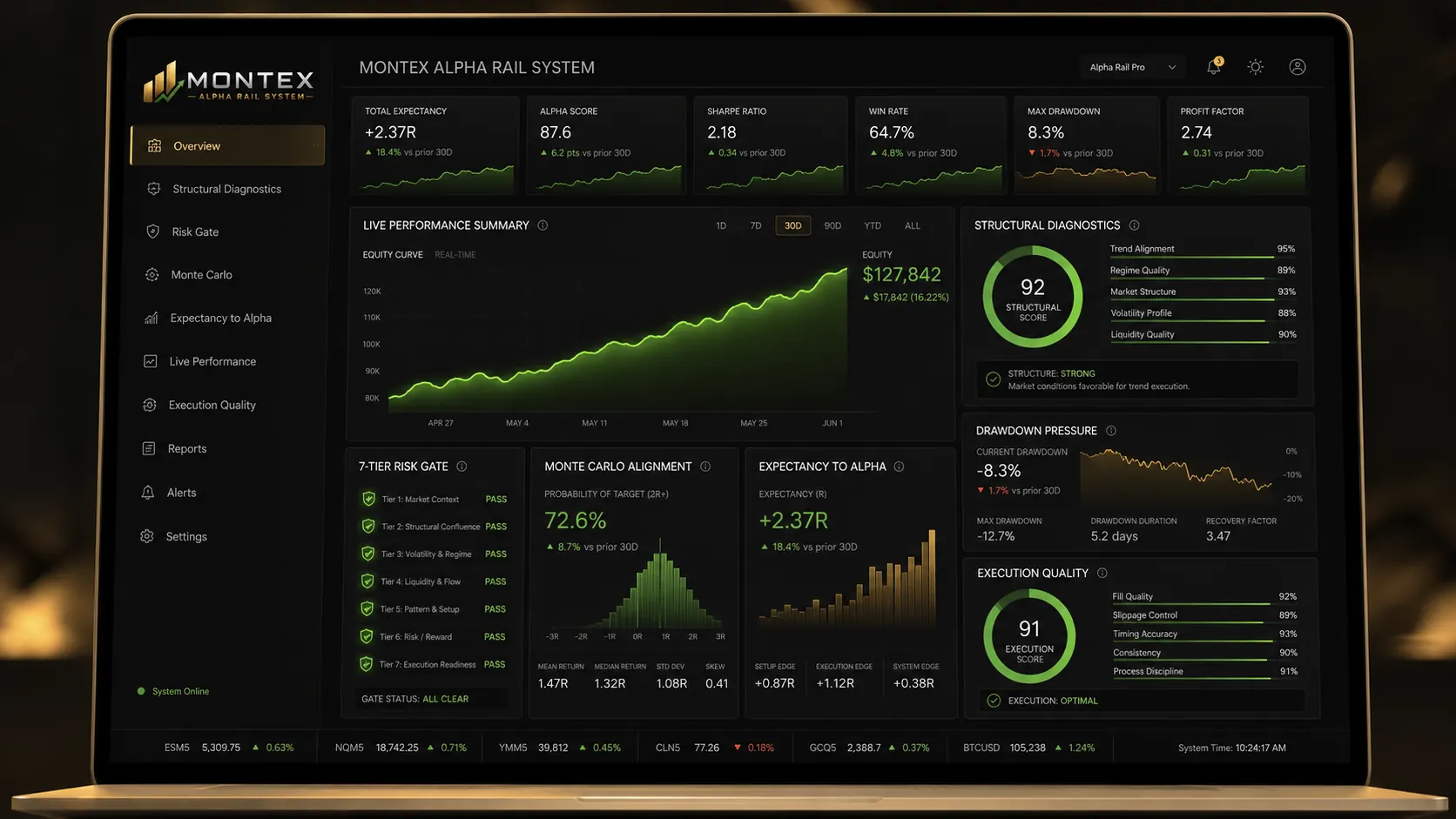
Every module ships in the complete MARS package.
One price. Eleven workbooks, three TradingView indicators, and the full manual library — $497.