
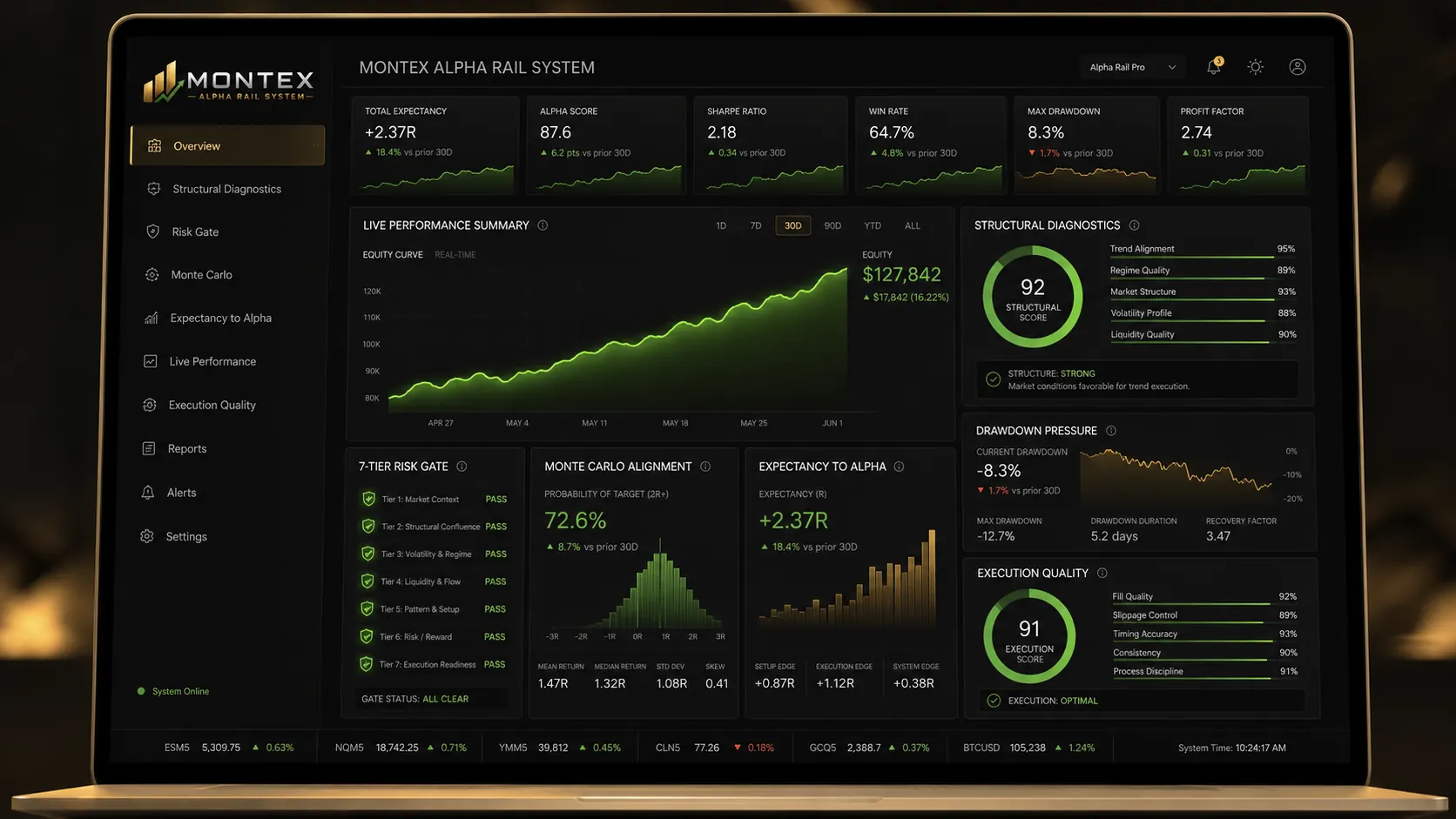
Workflow Overview · The Operating Loop
Nine stages, every week.
Read this first
The operating loop
01Nine stages, every week.
The modern loop runs: pre-trade verification → execution → post-trade capture → CP3 journal entry → weekly summary → EV scorecard → gate/brake review → cycle command & throttle control → volatility intelligence → structural diagnostics → regime classification → sandboxed R&D testing.
- Pre-trade: Trade Launch Checklist — session, news, spread, gate state, branch identity. Hard failure = skip.
- Execution & capture: Trade Capture Document filled immediately — identification, classification, risk, screenshots.
- Saturday discipline: every trade entered into CP3 Journal from capture sheets, verified against broker records.
- Weekly: Scorecard converts branch probabilities into EV; week tagged GREEN / YELLOW / RED.
- Monthly: Capital Dynamics, Regime classification, SDE structural read, scenario-profile comparison.
Where it lives
02Inside Workflow Overview.
This page expands one card of the Workflow Overview page into its own reference. For orientation, the module's own framing: MARS operates on a repeated rhythm across eight horizons — pre-trade, post-trade, daily/cycle, weekly, monthly, quarterly, annual, and structural. The loop is what turns raw activity into governed intelligence.
Stage dependencies
03Nine stages, and no stage can borrow from the future.
Each stage of the weekly loop consumes only completed upstream outputs — the scorecard cannot grade an unreconciled journal, the gate review cannot read an ungraded week. The dependency chain makes procrastination structural rather than moral: skipping Saturday's work doesn't create a small gap, it stalls the entire loop until repaid.
Connected inside MARS
This module doesn't work alone.
Go deeper
Operator briefs on this territory.
Deep dive — 01
Every stage consumes only completed upstream output.
Skipping Saturday doesn't create a small gap. It stops the chain, and everything downstream runs on last week.
Read the full brief →
Deep dive — 02
The week is the machine: MARS as a repeating rhythm.
Execute, capture, close the record, review, re-arm. The system is the loop, not the workbooks.
Read the full brief →
Deep dive — 03
Eight horizons, and why the loop is described as a rhythm rather than a process.
Eight horizons running at once. The weekly one is the carrier wave; the others ride on it.
Read the full brief →
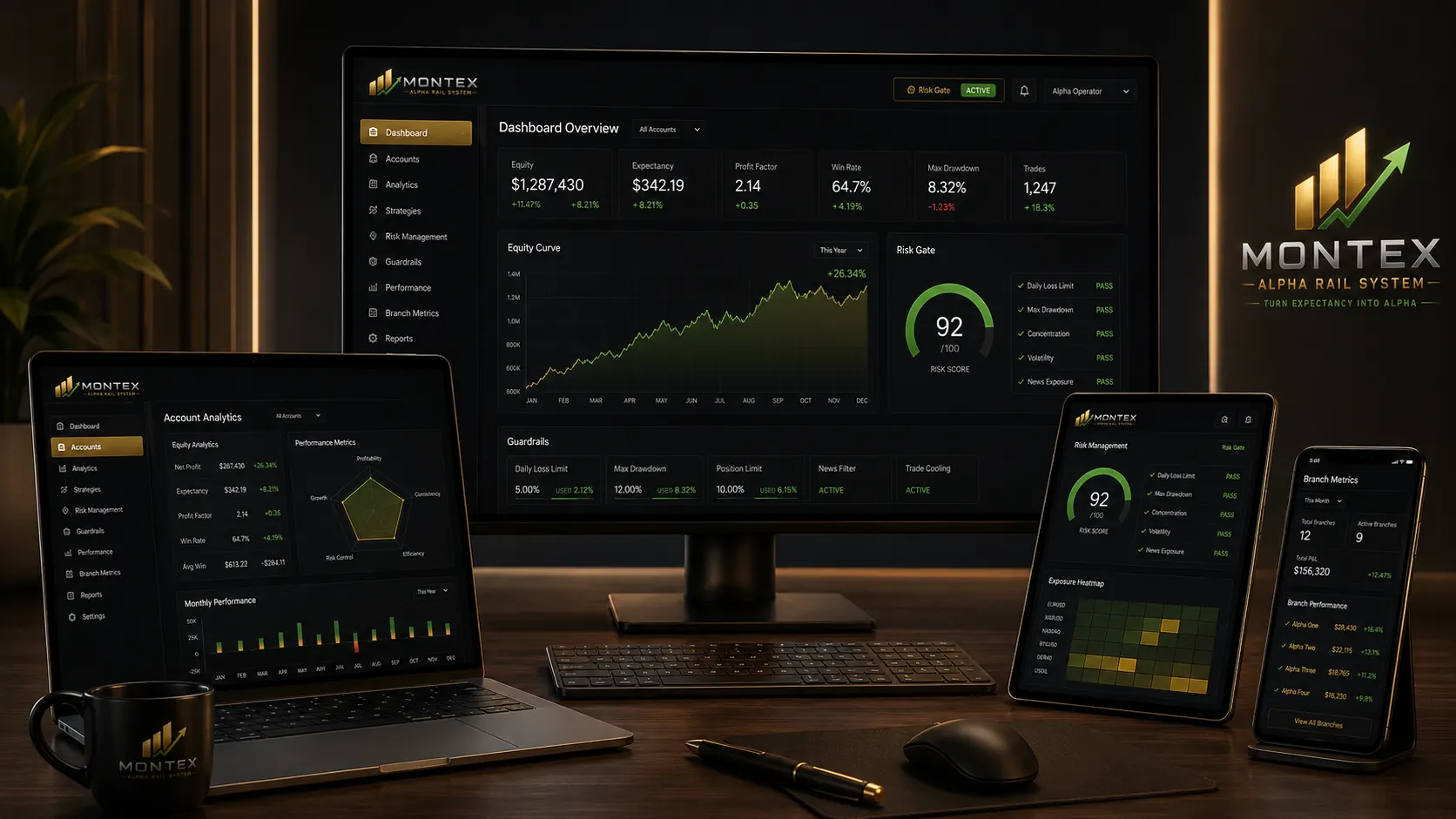
Every module ships in the complete MARS package.
One price. Eleven workbooks, three TradingView indicators, and the full manual library — $497.