
Branch Logic — Trend No-Partial
The fat-tail branch. Full exposure. Earned, not felt.
Layer 01 — Doctrine
Variance is the price of the right tail.
TNP exists because the legacy insight held: some trades need room to become outliers. But fat-tail logic becomes emotional acceleration the moment it's used without evidence. TNP must earn its use through quota compliance, EV support, SDE alignment, gate state, and clean ATR structure.
- Lowest trend weight by design: 11.25% — the tail wags nothing.
- The 1.8R hit flag tests delayed trail activation — does the highest-variance variant actually earn it?
- Execution red flags: low MFE, high MAE, poor survival to 1R/1.6R, or emotional tightening that prevents fat-tail capture.
Layer 02 — Governance
Quota-controlled, never mood-controlled.
Quota governance ensures TNP participation is neither ignored (under-monetizing clean trends) nor abused (variance addiction). The Weekly Scorecard tracks whether Trend No-Partial justified its variance — a question most traders never even ask.
How MARS uses this
Every workbook in MARS belongs to one of three layers. The evidence core records and grades what actually happened; the deployment rail converts capital state into governed risk; context and validation engines judge whether the environment and the structure can be trusted. Data crosses layers on defined rails - never informally.
How it benefits you
Eleven workbooks stay one coherent machine instead of a folder of spreadsheets. You always know which layer a number came from and which layer it is allowed to influence - so evidence informs, authority governs, and experiments never contaminate live rules.
The three-layer module ecosystem: evidence flows up from the core, authority flows down the deployment rail, context validates from above.
Layer 03 — Earning the right
The evidence stack TNP must pass.
Before a Trend No-Partial trade is even permitted, the seven-lens matrix runs: branch EV support, gate permission (Growth or clean Recovery), SDE alignment, clean ATR expansion, supportive structure, execution-quality history, and a stable variance regime. Miss the stack, and the trade routes to Trend Partial or Standard instead.
- Gate matrix doctrine: Buffer blocks casual aggression; Floor and below block aggressive variants entirely.
- The 1.8R delayed-activation flag exists to prove — not assume — that the highest-variance management earns its keep.
- Weekly quota keeps TNP participation deliberate: neither ignored in clean trends nor abused after losses.
Layer 04 — Variance budget
Full exposure buys the fat tail with deeper swings.
TNP pays for its outsized winners in equity-curve volatility: no partial means no early cash flow smoothing the ride. That is why the branch runs a small blend weight and a strict quota — the variance it injects is affordable at 11.25%, corrosive at 30%. The weight is the leash that lets the fat-tail hunt stay in the book at all.
Worked example
MARS is a closed loop, not a pipeline. Trades produce evidence, evidence produces weekly grades, grades move gate state, gate state feeds the throttle, and the throttle governs what the next execution is allowed to be. No stage is optional and no stage runs on memory or mood - each one reads the outputs of the stage before it.
The MARS operating loop: execute, capture, score, gate, throttle, deploy - every cycle feeding evidence into the next.
The governing idea
Connected inside MARS
This module doesn't work alone.
Go deeper
Operator briefs on this territory.
Deep dive — 01
The true accelerator: why some trades need room to become outliers.
Full exposure preserved for 3R, 4R, 5R+ continuation. The right tail is the entire product.
Read the full brief →
Deep dive — 02
Variance is the price of geometric growth — and 11.25% is what the system will pay.
The weight is the leash. Corrosive at 30%, affordable at 11.25% — and that is why the branch survives.
Read the full brief →
Deep dive — 03
Quota mechanics on the fat-tail branch: the ceiling, the floor, and the weekly count.
Neither ignored in clean trends nor abused after losses. Quota polices both directions weekly.
Read the full brief →
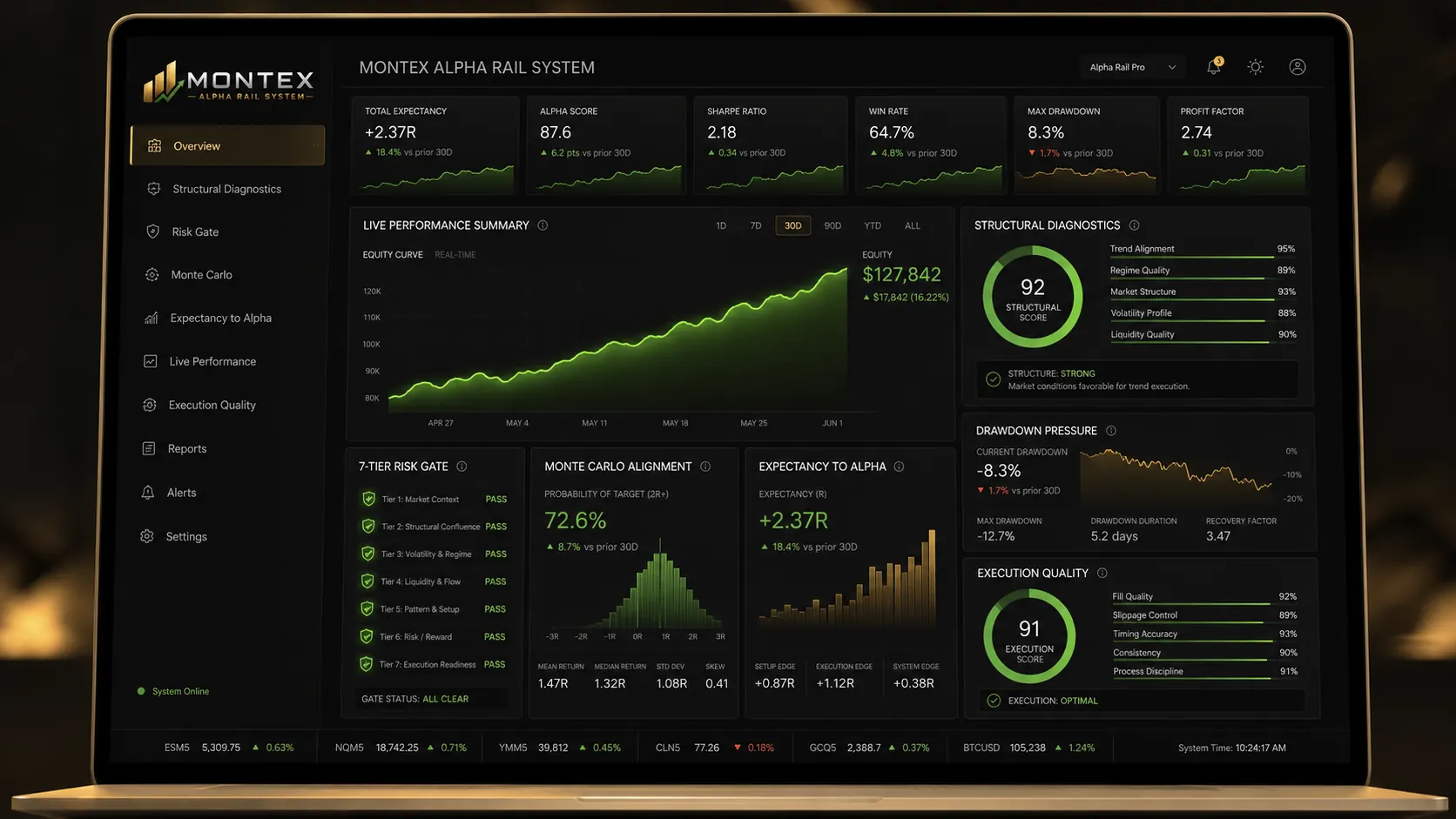
Every module ships in the complete MARS package.
One price. Eleven workbooks, three TradingView indicators, and the full manual library — $497.