Skip to content
← Back to The Symbol

Operator brief · 426

The category's animals are all predators. This one is not, and that is the entire choice.

The key idea

What a predator symbol encodes

Hunting imagery makes the market an adversary and activity a virtue.

The conventional animals all carry the same implicit model. A predator finds prey, pursues it, and eats — and every element of that transfers badly. It frames the market as something to be beaten rather than measured, it makes pursuit the central activity, and it treats a period without a kill as failure rather than as the ordinary state. The imagery is not decorative; it teaches an attitude, and the attitude it teaches is the one most operators already have too much of.

FigureWhat the symbol claims and what it declines
ClaimsWhat the animal asserts· Strength held in reserve· Territory, defended· Acts when it is worth it· Built to persistDeclinesWhat it refuses to imply· The market as prey· Aggression as skill· Activity as progress· Speed as an advantageConsequenceWhat follows for the product· Waiting is not failure· Refusal is a feature· Survival before spectacle

The middle column is what makes the choice legible. A brand that claims strength without declining anything has not said much.

The specific properties selected for

Powerful, disciplined, intelligent, patient, built for survival.

The five traits are chosen and they are not interchangeable. Power without discipline is the failure mode the whole system is built against. Discipline without power describes a trader who has stopped taking risk at all, which is not the goal either. Intelligence is what decides when the power should be spent, patience is what carries the interval between those moments, and survival is the constraint that outranks the rest — an animal optimised for anything other than continuing to exist would be the wrong emblem for a discipline where most participants stop.

The tension the symbol has to resolve

A brand built on strength, for a product that mostly constrains it.

There is a real awkwardness here worth naming rather than smoothing over. The system's day-to-day function is restrictive: it refuses trades, reduces sizing, and holds capital back. Leading with an image of overwhelming physical power sits oddly next to that, and a careless reading of the brand would expect an aggressive product. The resolution is the source line itself — strength is nothing without control — which says the power is real and the governance is what makes it usable. The emblem is not the strength. It is the pairing.

What the choice does commercially

It filters, and it is meant to.

An operator drawn to hunting imagery is being told, before reading a word of copy, that this is probably not for them. That is a deliberate cost. Predator branding converts better in this category precisely because it flatters the impulse most buyers arrive with, and declining it means declining the part of the market that wants to be told they are about to become dangerous. The compensating benefit is that the operators who do respond have already accepted the central premise, which makes everything downstream a shorter conversation.

  • The imagery pre-selects for someone who thinks restraint is a skill.
  • It converts worse and it argues less afterwards.
  • A symbol that appeals to everyone has not committed to anything.

The suit

Institutional dress on an animal that does not need it.

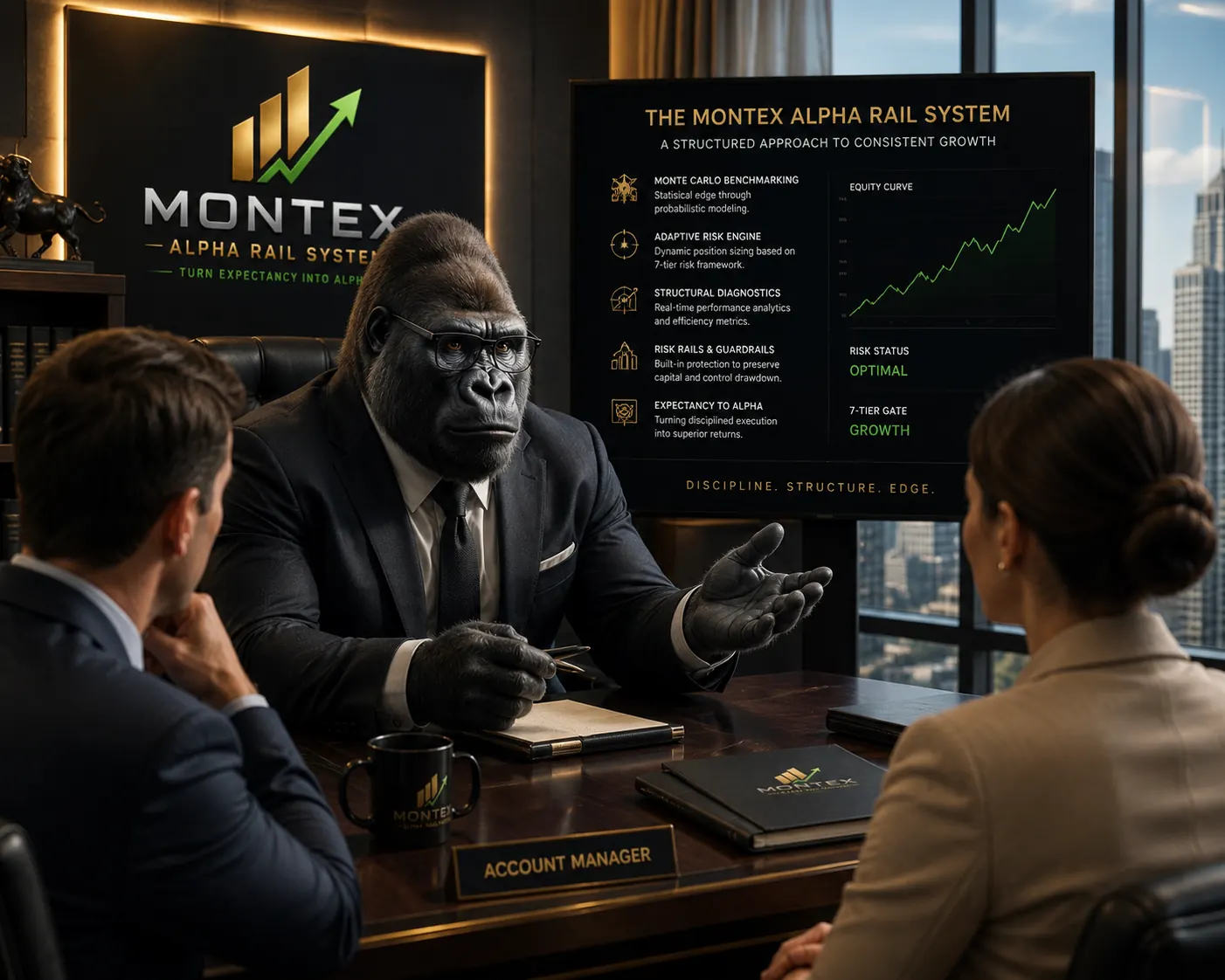
The gorilla is depicted suited, which is the second half of the choice. Nothing about the animal requires the costume — the strength is already unambiguous — so the suit is doing separate work: it locates the temperament inside a professional operating context rather than a wild one. That is the same claim the product makes, that institutional-grade process belongs in a discretionary retail setting. Read together, the figure is composure that already existed, dressed for the job it is now doing.

The key idea

The animal you decline says more than the one you choose.

Every brand in this category picks something strong, so strength alone distinguishes nothing. What separates them is what the animal implies about the relationship to the market, and there the field is nearly unanimous: pursue, catch, consume. Choosing a creature of comparable power that does none of those things is the most compressed available statement of the doctrine — that the edge belongs to the participant who is difficult to dislodge rather than the one who is hunting hardest.

Connected inside MARS

Every brief documents the same shipped system.

The complete MARS package — eleven workbooks, three TradingView indicators, the full manual library — $497.